


When “Approve” is Dangerous: How Rabby Wallet Extension Changes the Risk Equation for DeFi Power Users
October 31, 2025 6:33 pmImagine you’re on a trial run with a new DeFi strategy: a leveraged swap + LP position across Arbitrum and Polygon. You click “connect,” and the dApp asks for an approval that, in the past, you might have mechanically granted and forgotten. That one click can be the difference between a profitable trade and a drained wallet. Rabby Wallet’s browser extension addresses that precise scenario by changing the information the wallet exposes before signing—it’s designed to stop “blind signing.”
This article is for DeFi power users in the US who already understand wallets and private keys but want a clearer mental model of where Rabby fits, what it concretely protects against, and where operational discipline still matters. I’ll explain the mechanisms Rabby uses, compare the trade-offs with familiar alternatives, correct common misconceptions about what transaction simulation can and cannot guarantee, and end with practical heuristics you can reuse immediately.
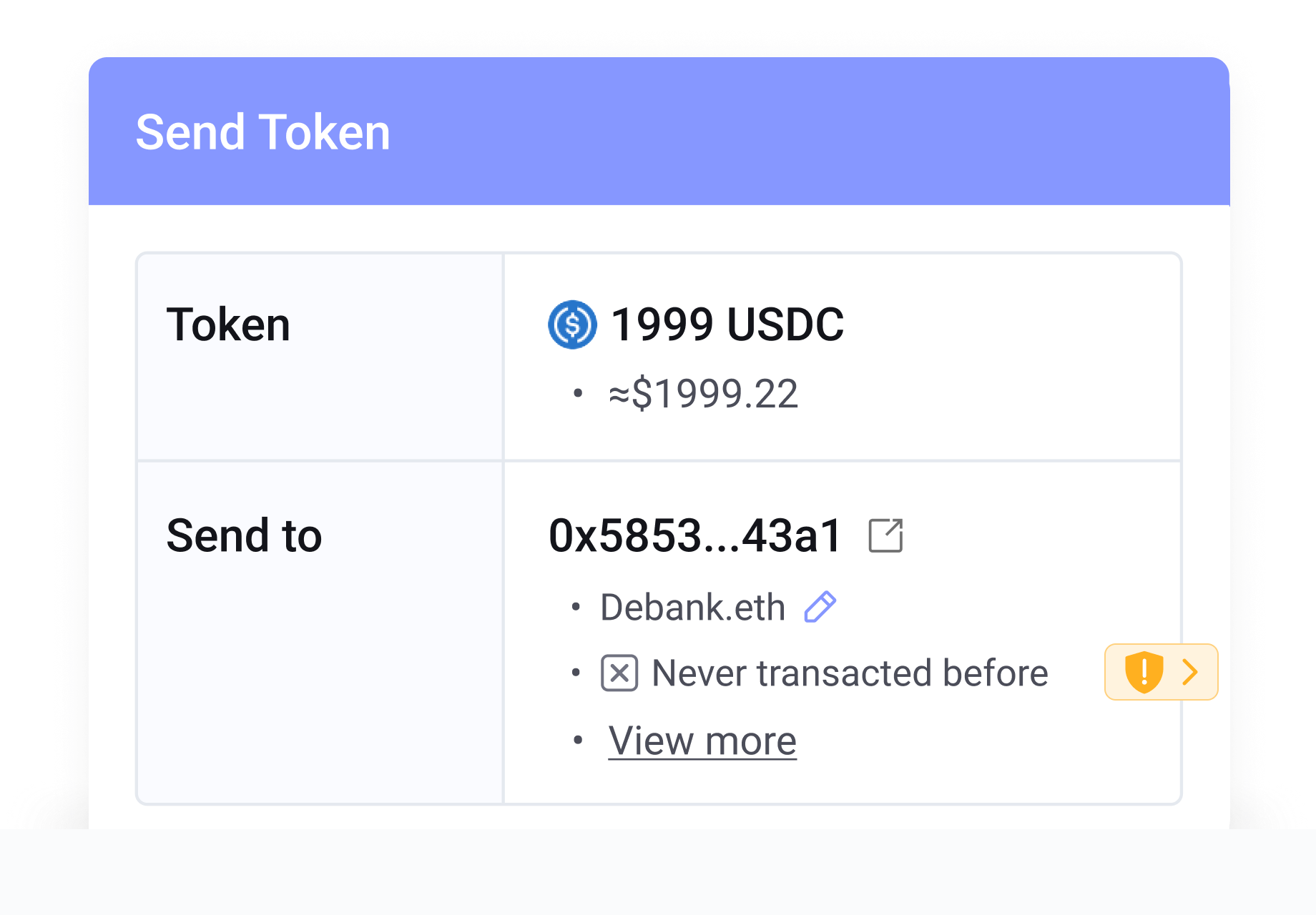
How Rabby’s pre-transaction stack works — mechanics, not slogans
Rabby is built around three linked defensive mechanisms that change the signing decision from a black box into a transparent checklist: transaction simulation, pre-transaction risk scanning, and explicit balance-change display. Mechanically, when a dApp requests a signature, Rabby first executes an off-chain simulation of the call (replaying the intended transaction against a recent node state). That produces exact estimated token balance changes and an estimated fee. On top of the simulation runs a security engine that checks for red flags—known hacked addresses, abnormal approval sizes, or non-existent recipient addresses. Finally, Rabby presents the user with a concise, numeric summary of what will change on their balances if they proceed.
Why this matters: the usual model—“sign then see what happens”—leaves the user vulnerable to malicious contracts that repurpose approvals or construct transactions that drain funds through intermediate steps. Simulation converts a many-step attack into a single, inspectable output: these are the tokens that will move and these are the fees you’ll pay. That’s powerful because it reduces the cognitive load on the user and makes many otherwise invisible attacks visible before signing.
What Rabby protects against — and what it does not
Protection scope (strong evidence): Rabby materially reduces the risk of blind-signing attacks and suspicious approvals by showing balance deltas and flagging risky contracts. It also reduces operational mistakes through automatic network switching and a cross-chain gas top-up feature—useful when you accidentally land on an L2 without native gas. Integration with hardware wallets and institutional multi-sig solutions (Gnosis Safe, Fireblocks, Amber, Cobo) shifts custody risk toward devices and policies you control, not the extension.
Limits (important boundary conditions): simulation is as good as the state snapshot and the model it uses. If a malicious dApp constructs logic that depends on external oracle states that can change between simulation and execution, or if front-running and MEV alter the effective outcome, the simulated result may not fully match final execution. Also, Rabby does not eliminate phishing or social-engineering risks—if you approve a malicious dApp because you misidentify it, simulation will show the resulting transfer but won’t magically prevent you from confirming it. Finally, Rabby lacks an in-wallet fiat on-ramp and native staking features—so it is not a one-stop consumer app for buying or staking tokens without leaving the wallet.
Comparative trade-offs: Rabby vs MetaMask, Trust Wallet, Coinbase Wallet
Most alternatives focus on broad consumer reach or central-exchange convenience. Rabby differentiates itself with built-in transaction simulation and automatic network switching. Mechanistically, that means Rabby adds a pre-execution validation layer where MetaMask traditionally exposes a raw ABI call and a gas estimate. The trade-off is complexity: Rabby offers more pre-sign information, which benefits active DeFi traders who can interpret balance deltas. For casual users, the extra details may appear noisy unless coupled with good operational habits.
Security-wise, Rabby’s open-source MIT codebase and hardware wallet integrations let external auditors and institutions fold Rabby into hardened processes. But openness doesn’t equal immunity: the 2022 Rabby Swap contract exploit (roughly $190k lost) is a reminder that wallet-level protections cannot retroactively immunize every smart contract that interacts with users. Rabby’s response—freezing the contract and compensation, plus improved audits—illustrates a realistic risk-management lifecycle: detection, mitigation, remediation.
Operational heuristics: how to use Rabby like a security engineer
Here are decision-useful rules you can apply immediately:
1) Treat simulation output as a hypothesis, not a guarantee. If the delta shows large token outflows, step back and verify contract legitimacy off-chain.
2) Use hardware wallets with Rabby for high-value wallets. The extension adds clarity; the device retains custody. That reduces exposure from stolen extension states or browser compromises.
3) Use the approval revocation tool actively. Revoke allowances for DEXes and protocols you don’t actively use—this reduces the attack surface without needing to trust a third party.
4) For institutional flows, prefer Rabby’s multi-sig integrations. A Gnosis Safe fronted by Rabby’s UX keeps checks-and-balances that a single-signer flow cannot.
5) Don’t conflate automatic network switching with security. It prevents user error when landing on a different chain, but still confirm that the dApp domain is legitimate and that the contract address matches independent sources.
Myth-busting: three common misconceptions
Misconception 1 — “Simulation makes signing risk-free.” Correction: Simulation reduces information asymmetry but cannot eliminate execution-time oracle changes, MEV, or user-operated errors. It is a strong preventive control, not a bulletproof guarantee.
Misconception 2 — “Open-source means no backdoors.” Correction: Open-source code increases auditability and community trust, but practical security depends on active audits, responsible disclosure, and patching cycles. Human processes and deployment practices matter as much as the license.
Misconception 3 — “Rabby replaces hardware wallets.” Correction: Rabby integrates with hardware devices to improve security; it does not replace the hardware root of trust. For significant funds, combine both.
What to watch next — conditional scenarios and signals
Three things will meaningfully change Rabby’s position in the US DeFi ecosystem if they occur: broader native fiat on-ramps (would make Rabby more consumer-facing), deeper L2-first UX innovations that reduce cross-chain friction (would raise the bar for any wallet), and measurable industry-standardization of transaction simulation outputs (if multiple wallets agree on a simulation standard, it would make the pre-sign stage a widely interpretable security primitive). These are conditional scenarios—each depends on developer incentives, regulatory clarity in the US for on-ramps, and community adoption.
If you value measurable pre-sign information, hardware compatibility, and active approval controls, Rabby is a defensible choice to test in an operational environment. For readers ready to explore it further, you can find more about installation and platform coverage at rabby wallet.
FAQ
Q: Does Rabby prevent all smart contract exploits?
A: No. Rabby mitigates user-facing risks (blind signing, reckless approvals, wrong-network transactions) by surfacing simulations and risk flags. It cannot prevent bugs inside third-party smart contracts or guarantee outcomes that depend on external data changing between simulation and execution.
Q: Can I use Rabby with a Ledger or Trezor device?
A: Yes. Rabby supports multiple hardware wallets (Ledger, Trezor, Keystone, and others). Pairing a hardware device keeps your signing keys off the extension and is recommended for high-value accounts.
Q: Is Rabby safe for institutional use?
A: Rabby integrates with institutional and multi-sig solutions such as Gnosis Safe and Fireblocks, which helps align it with enterprise custody workflows. But institutions should still perform their own audits and operational reviews before adopting any wallet in production.
Q: How does Rabby help with cross-chain gas problems?
A: Rabby includes a cross-chain gas top-up feature that lets you send gas tokens into a target network to enable transactions there. This addresses a common friction point when you hold tokens on one chain but need gas on another.