


Rabby Wallet and the Myth of Perfect Signing: How Transaction Simulation Changes the Risk Equation
July 31, 2025 1:20 pmA common misconception among DeFi power users is that a wallet’s security is primarily about cold storage and private-key secrecy. That is necessary, but incomplete. What separates a competent wallet from a defensible one in active DeFi use is the ability to see into a transaction before you irrevocably sign it. Rabby’s transaction simulation — and the ecosystem design decisions that enable it — force us to rethink “what a wallet should do” from key custody to pre-commitment visibility.
This article explains how Rabby’s browser wallet implements simulation, what it actually protects you from (and what it does not), and how that protection trades off against usability and trust surface. I’ll give a practical framework you can reuse when choosing or configuring any multi-chain wallet in the U.S. market, and I’ll highlight the limits you must accept if you want the benefits of fast, multi-chain DeFi interactions.
What Rabby’s transaction simulation is — mechanism, not magic
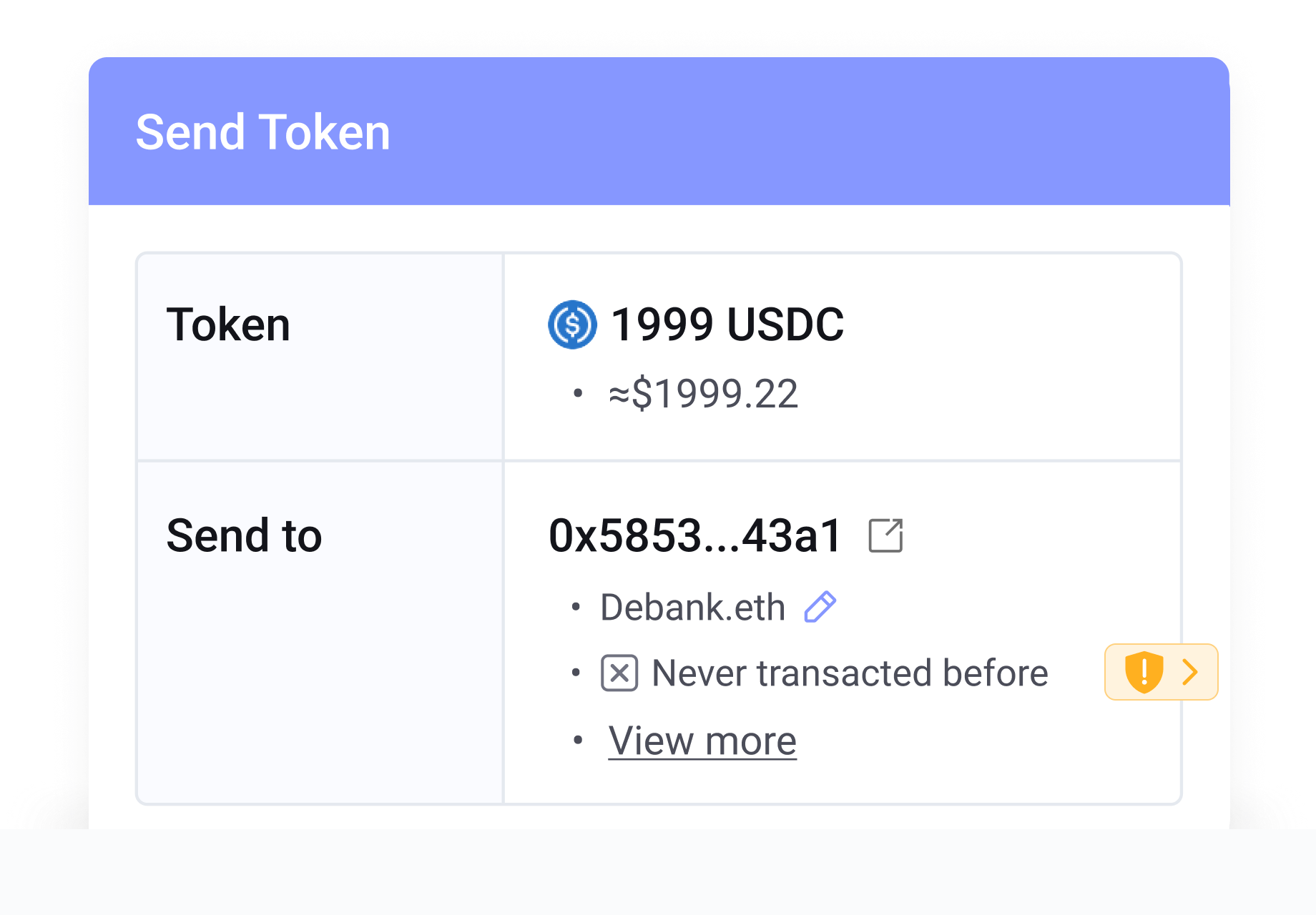
At its core, Rabby’s transaction simulation executes a read-only “dry run” of a prospective on-chain transaction against a node or simulation engine and displays the expected outcome: token balance changes, gas consumed, and where applicable, what approvals or contract calls will do. Mechanically this uses the same EVM semantics as a normal call but without broadcasting a state-changing transaction; it replays the instruction trace against the current chain state so the user sees estimated token deltas and fee costs before signing.
This matters because many attacks and user errors depend on asymmetric information: the dApp or the contract can ask you to “sign” something whose consequence you cannot infer from a simple allowance number. Simulation surfaces the end-state: did the swap actually send 1,000 USDC to your wallet, or did it silently transfer your tokens to an intermediary contract? Did a “token approval” give a contract unlimited withdrawal rights? Rabby’s built-in security engine augments simulation by flagging previously hacked contracts, suspicious approval sizes, and non-existent recipient addresses — a hygiene layer you don’t get if you simply hit “confirm” in a minimal wallet interface.
How simulation changes the risk calculus — three concrete benefits
Benefit 1 — Preventing blind signing: Blind signing is the practice of approving transactions without adequate visibility into their effects. Simulation converts blind signing into informed consent by showing expected balance changes and gas ahead of commit. For traders executing many swaps across chains, that small overhead lowers the chance of catastrophic mis-signing.
Benefit 2 — Better approval management: Combined with Rabby’s native approval revocation tool, simulation helps manage the long tail of approval exposure. You can see what an approval will permit and then, after use, revoke it. This reduces the window during which a compromised dApp or contract can drain funds.
Benefit 3 — Safer multi-chain workflows: Rabby supports over 90 EVM chains and automatically switches networks to the one a dApp requires. Simulation preserves safety during network-flipping because it evaluates the exact target chain semantics and current state rather than assuming uniform behavior. That matters in cross-chain DeFi where a misrouted transaction or wrong-network confirmation can cost time and capital.
Where simulation helps least: limits and boundary conditions
Simulation is powerful but not omnipotent. First, it depends on the node or simulator’s view of state. If the node is out-of-sync or if the contract’s behavior depends on off-chain inputs (an oracle update scheduled after the simulation), the dry-run can be a misleading preview. Second, simulation cannot reveal malicious intent embedded in complex, dynamic contracts that change behavior after they have received multiple approvals — it only evaluates the immediate call in the present state. Third, simulation does not protect private keys: hardware-wallet integration remains essential and Rabby properly supports Ledger, Trezor, Keystone and others for that reason.
Finally, simulation reduces but does not eliminate social-engineering risks. A malicious dApp can simulate a benign swap and then lure you into signing a second transaction that strips funds, or use relative-time tricks. Rabby’s pre-transaction risk scanning shrinks this surface, but user vigilance and institutional controls (multi-sig, enterprise custody with Fireblocks or Gnosis Safe) remain necessary when moving large sums.
Operational trade-offs: speed, privacy, and centralization
Running a simulation requires querying a node or an execution engine. Rabby’s choice to include simulation in the wallet improves safety but introduces trade-offs. Latency: simulations add milliseconds to seconds to each signing flow — tolerable in most DeFi interactions, but it can matter for arbitrage or time-sensitive MEV strategies. Privacy: simulation endpoints may observe the transactions you intend to sign. Rabby mitigates this through client-side checks and open-source tooling, but any wallet that uses third-party RPCs must be judged on its default RPC configuration and whether you can switch to a private node.
Centralization: if a wallet’s simulation backend is controlled by a single provider, that provider becomes an attractive target for manipulation or surveillance. Rabby’s open-source architecture and support for custom RPCs reduce this concern in principle, but it remains a trade-off users should manage by choosing their RPC or routing through private infrastructure for high-value operations.
Comparisons and what Rabby prioritizes
Compared to mainstream alternatives like MetaMask, Trust Wallet, or Coinbase Wallet, Rabby explicitly prioritizes pre-signature visibility and automated network handling. That design shows in features: automatic network switching eliminates manual mistakes when users connect to Arbitrum vs. Optimism; the Flip toggle lets desktop users switch between Rabby and MetaMask as the default extension, easing migration for experienced traders. Rabby also bundles portfolio aggregation and approval revocation — features that, taken together, create a workflow oriented to active DeFi users rather than casual holders.
But Rabby does not try to be everything. It lacks an in-wallet fiat on-ramp and native staking capabilities today, which means U.S. users will still rely on centralized exchanges or separate staking interfaces for some flows. For institutions and teams, Rabby integrates with multi-sig and custody partners (Gnosis Safe, Fireblocks, Amber, Cobo) rather than reinventing those enterprise controls — a sensible modular approach that reduces duplicated risk.
Practical decision framework: when to rely on simulation and when to add layers
If you are a frequent DeFi trader or a liquidity provider, use simulation as your first line of defense for every non-trivial transaction: enable hardware-wallet signing, keep RPC endpoints under your control for high-value ops, and use Rabby’s approval revocation immediately after token approvals. For simple passive holding or long-term cold-storage, simulation helps but is less critical than key isolation.
When handling institutional funds, combine Rabby’s simulation with multi-sig workflows and on-chain policy enforcement (transaction batching, timelocks). Treat the simulation result as a safety checkpoint, not a substitute for role-based checks or external audits.
Recent context and what to watch next
Rabby recently presented itself as a default “go-to” for EVM chains, emphasizing simplicity and security across browser and desktop platforms. That positioning is consistent with the product choices described above. What to watch: whether Rabby expands its simulation capabilities to incorporate cross-transaction or temporal analyses (for example, simulating a sequence of approvals and transfers), and whether it broadens on-chain privacy protections for simulation queries. Adoption signals to monitor include default RPC diversity, third-party security audits, and whether more institutional custody providers list Rabby as an integrated front end.
Another relevant signal is how the team responds to rare but instructive incidents. A past exploit linked to Rabby Swap in 2022 resulted in an exploited contract and a ~ $190,000 impact; the team froze the contract, compensated users, and strengthened audits. That history matters: it shows both a risk vector (contracts pushed under the Rabby brand) and an organizational capability to respond and iterate. For risk-minded U.S. users, incidents plus transparent remediation and audit practices carry more weight than marketing claims.
Concrete heuristics for DeFi power users
– Never blind-sign: insist on simulation or equivalent pre-sign checks; if your wallet does not show expected balance deltas, do not proceed. – Pair simulation with hardware signing: simulation shows what happens; hardware signing enforces that only the holder of the key can execute it. – Limit approvals and revoke aggressively: use Rabby’s native revocation tool after each granting event. – Control RPCs for big trades: point the wallet to your own node or a vetted private RPC to protect transaction intent privacy. – Use institutional integrations for treasury-level risk: combine Rabby’s front-end safety with a multi-sig backend like Gnosis Safe.
FAQ
Does Rabby’s simulation guarantee a transaction will succeed on-chain?
No. Simulation predicts outcome based on the current chain state and the local execution environment. If state changes (oracle updates, mempool front-running, or reorgs) occur between simulation and inclusion, the real transaction can still fail or behave differently. Treat simulation as a high-quality estimate, not a hard guarantee.
How does Rabby handle hardware wallets during simulation?
Rabby supports major hardware devices (Ledger, Trezor, Keystone, etc.). The simulation runs off-chain and only displays results; the actual signing remains on the hardware device. This split preserves the security boundary: visibility is provided by the wallet, signing authority stays on the hardware.
Can simulation reveal hidden malicious logic in contracts?
Not always. Simulation evaluates the transaction in the present state. Contracts that change behavior over time, rely on off-chain inputs, or require a sequence of calls can behave maliciously in contexts a single simulation will not capture. That’s why multi-layer defenses (audits, approval limits, revocation tools, and institutional checks) remain essential.
How does Rabby compare to MetaMask on network switching and approvals?
Rabby emphasizes automatic network switching to match dApp requirements and includes built-in approval revocation and pre-transaction risk scanning. MetaMask is more ubiquitous but less opinionated about pre-sign simulation; power users who interact with many EVM chains may prefer Rabby’s automatic switching and explicit simulation-focused design.
For DeFi power users in the U.S., Rabby represents a pragmatic midpoint between raw key custody and active transaction-level safety. It does not remove the need for hardware wallets, institutional controls, or careful operational practice — but by turning blind-signing into visible, actionable information, Rabby materially reduces a class of human and contract-level errors that have historically caused large losses.
If you want a hands-on test of these ideas, install the browser extension or desktop client, connect a hardware wallet, and execute a non-critical swap while watching the simulated deltas and approval prompts. You can learn quickly whether the workflow fits your risk profile. For more details about the extension and supported platforms, see rabby wallet.